Three months ago, we launched what we believe is the world’s first AI-native customer success organization. Here’s what we learned about transforming not just workflows, but the fundamental nature of CX work itself.
The Genesis: Reimagining What’s Possible
It started with a simple observation: every role around us was evolving with AI. Engineers were coding differently with tools like Cursor, fundamentally changing how they approached development. Content writers had AI as thinking partners, shifting from lengthy first-draft processes to collaborative iteration. Designers were creating working prototypes in minutes instead of days.
In customer success, we were doing our jobs well—EBR preparation took several hours of hard work, account handoffs involved thorough context gathering across multiple systems, and support ticket analysis required careful manual review. This is just how CX work got done in our world so far. It was so ingrained as “part of the job” that we rarely questioned it.
But as AI began transforming other roles, we started asking a different question: if we didn’t just accept the current way of running our function as the only way, how could we reimagine it? What if we could bring down EBR prep time from hours to minutes? What if support ticket summaries could be generated instantly? More importantly, what if each member of our CX team got more time back in their day to 10X their impact?
The fundamental insight was simple: time is a finite resource. If our team was spending significant portions of their day preparing for customer interactions instead of actually having more meaningful conversations, we were optimizing for the wrong thing. With the same 8 hours in a workday, why should half of that go toward grunt work that could be automated? The real value we bring to customers is helping them move forward strategically—what if we could focus entirely on that instead of spending time on information processing?
The opportunity was clear: while we were effectively managing customer relationships, we could create exponentially more value by staying on top of customer health signals and strategic opportunities rather than spending hours consuming and synthesizing information across multiple accounts.
That’s when we asked ourselves: if we could rebuild our CX organization with AI-first principles, what would it look like?
Designing the AI-Native Blueprint: The Jobs-to-be-Done Revolution
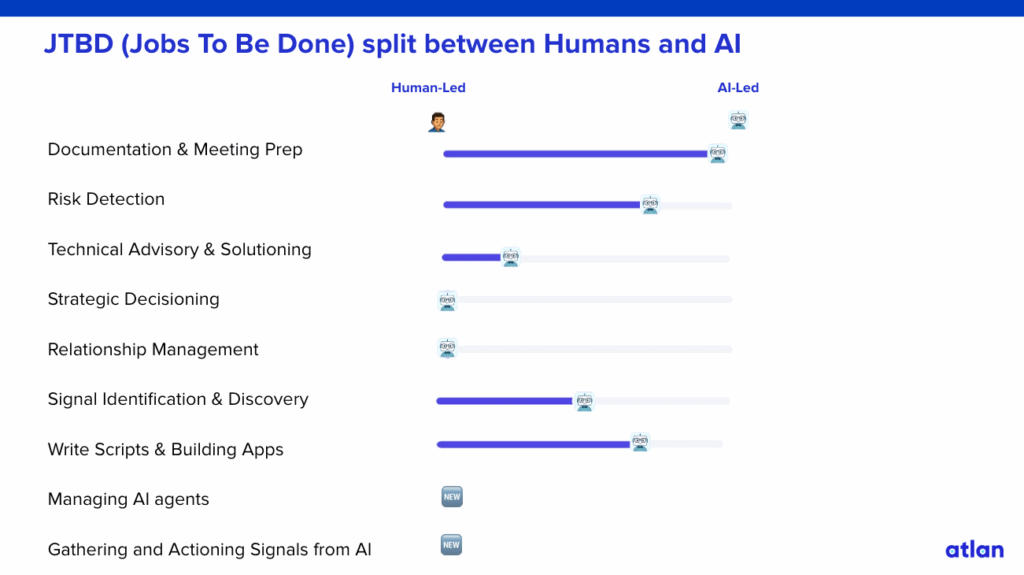
We didn’t start by asking “how can AI help us?” Instead, we went back to the whiteboard and mapped every single job our team does today: Documentation and meeting prep, risk detection, technical advisory. etc.
For each job, we placed it on a spectrum from Human-led to AI-led. The visual framework revealed clear patterns:
- Heavily AI-Led: Documentation & Meeting Prep, Risk Detection, Write Scripts & Building Apps
- Mixed/Collaborative: Technical Advisory & Solutioning, Signal Identification & Discovery
- Primarily Human-Led: Strategic Decisioning, Relationship Management
- New Skills Emerging: Managing AI agents, Gathering and Actioning Signals from AI
This framework revealed something crucial: we weren’t just adding AI tools to existing roles. We were fundamentally redesigning what it means to work in customer success. But this insight didn’t come immediately—it emerged through experimentation and learning across multiple iterations.
Our Hypothesis: The Future We’re Building Toward
As we mapped out the jobs-to-be-done, we developed a clear hypothesis about where customer experience is heading—and it informed every decision we made about building our AI organization.
The value of CX lies in judgment, not grunt work. AI will allow us to shift focus from operational tasks to strategic advisory work. In a world where CX professionals need to consume vast amounts of content across multiple accounts to make decisions, humans simply can’t process that much context—but LLMs can, and they’ll keep getting better.
Everyone in CX needs to consume a lot of content to make decisions, and it’s impossible to keep up when you’re handling multiple accounts. Humans can’t process that much context. But LLMs can, and they will keep getting better.
AI will give signals from all the context, but the final decision, discovery, or advisory will still need to come from humans—whether it’s business case discovery, data governance advisory, or building custom apps.
Human trust, empathy, and relationships will become even more valuable in this world and will be a premium. As AI commoditizes information processing, human connection becomes the competitive advantage.
CX will, by default, become a more proactive and advisory function, rather than a reactive, escalation-driven one. The shift from firefighting to strategic partnership is what this transformation enables.
CX will not disappear, but it will create more impact. The impact CX can have for the customer and the company will 10x when freed from administrative overhead to focus on strategic outcomes.
This hypothesis drove us to build an AI org that handles the information processing and routine work, so humans could focus entirely on the strategic, relationship-driven work that creates exponential value.
Building the AI Organization: A Team of Specialists
Once we understood which jobs should be AI-led versus human-led, we faced a critical design question: how should we structure the AI capabilities to support our CS team?
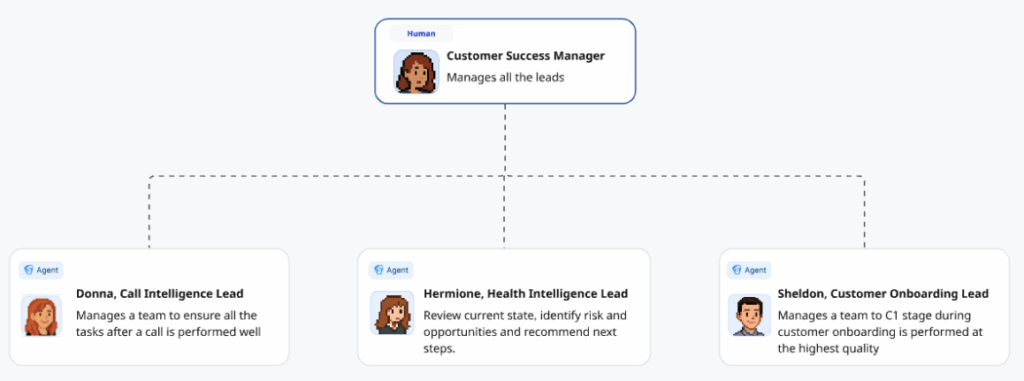
We landed on a radical concept: every CSM would have their own organization of AI agents reporting to them. Just like a VP of Customer Success might have specialized leads reporting to them, each CSM would have specialized AI agents, each with their own supporting agents underneath.
A CSM’s core responsibility is to drive customer value through strategic conversations. This includes analyzing account health, ensuring customers reach key value milestones, guiding them through onboarding, and managing renewals effectively. Hence, we built an AI org where a CSM has three primary lead agents, each owning a distinct area of customer success work:
- Hermione (Health Intelligence Lead): Reviews current state, identifies risks and opportunities, and recommends next steps for account health
- Donna (Call Intelligence Lead): Manages all the tasks after a call is performed—summaries, action items, follow-ups
- Sheldon (Customer Onboarding Lead): Manages the team to ensure the C1 stage during customer onboarding is performed at the highest quality
How Lead Agents Work: The Hermione Example
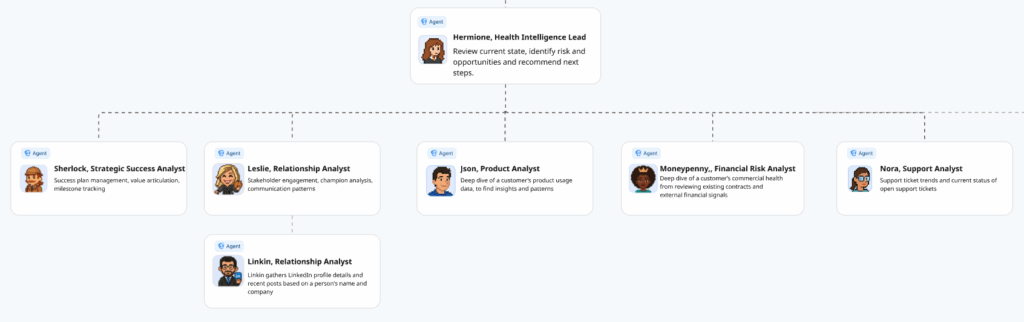
Let’s take Hermione to understand how a lead agent actually functions. Hermione doesn’t work alone—she manages her own team of specialist agents who focus on different aspects of customer health:
- Json (Product Analyst): Deep dives into the customer’s product usage data to find insights and patterns
- Moneypenny (Financial Risk Analyst): Reviews commercial health, contract status, and financial signals
- Leslie (Relationship Analyst): Tracks stakeholder engagement and communication patterns
When a CSM asks Hermione about account health, she coordinates with her specialist team to pull comprehensive insights. Json might surface concerning adoption trends, Moneypenny flags an upcoming renewal risk, and Leslie notes decreased stakeholder engagement. Hermione synthesizes all these signals into actionable recommendations for the CSM.
This organizational structure meant we weren’t building one super-agent trying to do everything—we were building a specialized team where each agent had deep expertise in their domain, just like a well-structured human organization.
The Foundation: Leadership Buy-in and Strategic Priority
Before diving into the technical journey, it’s crucial to understand what made this transformation organizationally possible. As a company, Atlan is deeply AI-first in our DNA. This project received direct sign-off from our founders and leadership team—it wasn’t a side experiment, but a strategic priority that was consistently celebrated and featured in town halls, leadership meetings, and company offsites.
From Concept to Reality: Our 4-Phase Implementation Journey
The Team Behind the Transformation: Leadership established a dedicated pod exclusively for this initiative, ensuring we had the right skill mix from day one. The team included people with deep CSM experience who understood the day-to-day reality of customer success work, cross-functional collaborators, change management specialists, technical AI analysts, and AI engineers. This wasn’t a technology team trying to solve business problems or a business team struggling with technical implementation—it was an integrated unit with all necessary capabilities.
Two critical success factors emerged: unwavering problem conviction (the team never questioned whether this was worth solving) and comfort with iteration (leadership understood this would be a journey with multiple pivots, not perfection from day one).
Phase 1: Notebook LLM Experiments (January-February)
- We started with Google’s Notebook LLM – a tool that could analyze entire document sets and create comprehensive summaries
- A small 2-person team would take all of a customer’s call transcripts, upload them to Notebook LLM, and generate detailed account contexts and insights
- This gave us rich, thorough analysis of customer relationships and health, but required manual work for each account
- Key learning: The quality of insights was excellent, but we needed something scalable that the entire team could use self-serve
Phase 2: Intel Engine – The AI Sidekick (March-May)
- We built an internal system where team members could run pre-built queries against our different data sources – health analysis, support summaries, call insights etc
- Think of it as a library of proven AI prompts that anyone could use, eliminating the need to write prompts from scratch each time
- Team members could pull insights for any customer instantly, and we could share successful prompt templates across the organization
- This was purely insight-oriented and non-agentic – AI would analyze and inform, but couldn’t take actions
- Key learning: Self-serve was crucial, but users wanted to also save conversations with the AI. They also wanted to chain different prompts (for example, run a health prompt and summary prompt together and have a summarised output)
Phase 3: The Agent-Based Breakthrough (June-July)
- We created specialized conversational AI agents – Hermione for health intelligence, Json for usage analytics, and others for specific expertise areas
- Instead of running static queries, team members could have ongoing conversations, ask follow-up questions, and drill deeper into insights
- Crucially, we enabled agents to actually do things: dynamically query Snowflake, update documents and sheets, and interact with MCPs/APIs autonomously
- Each agent had specialized knowledge and personality, making interactions feel more natural and productive
- Key learning: Specialized agents consistently delivered better results than generic ones, and moving from insight-only to action-capable agents unlocked exponentially more value
Phase 4: Full Launch with Theatrical Flair (August)
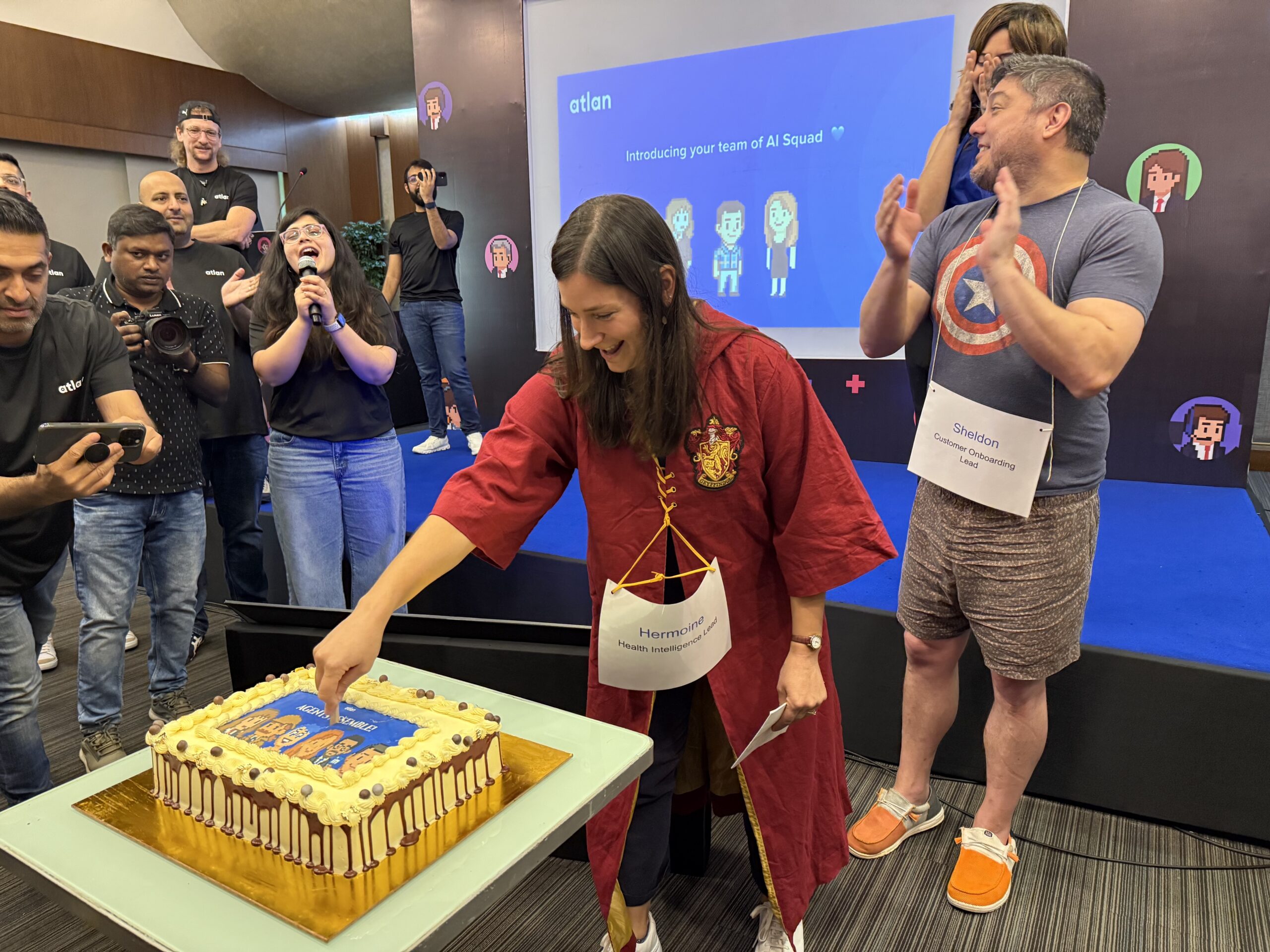
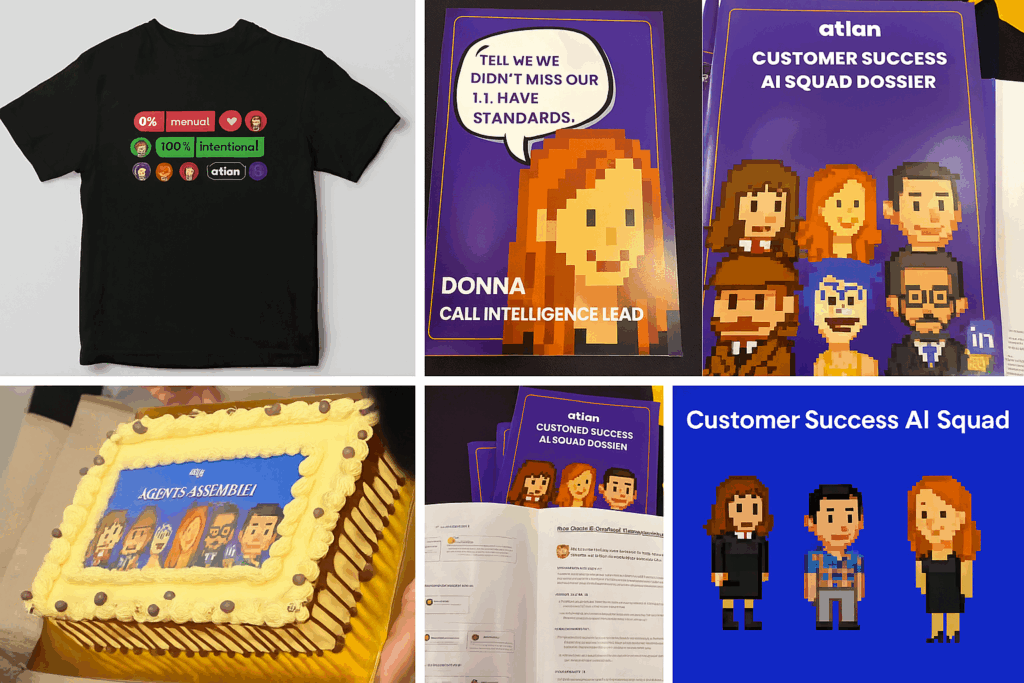
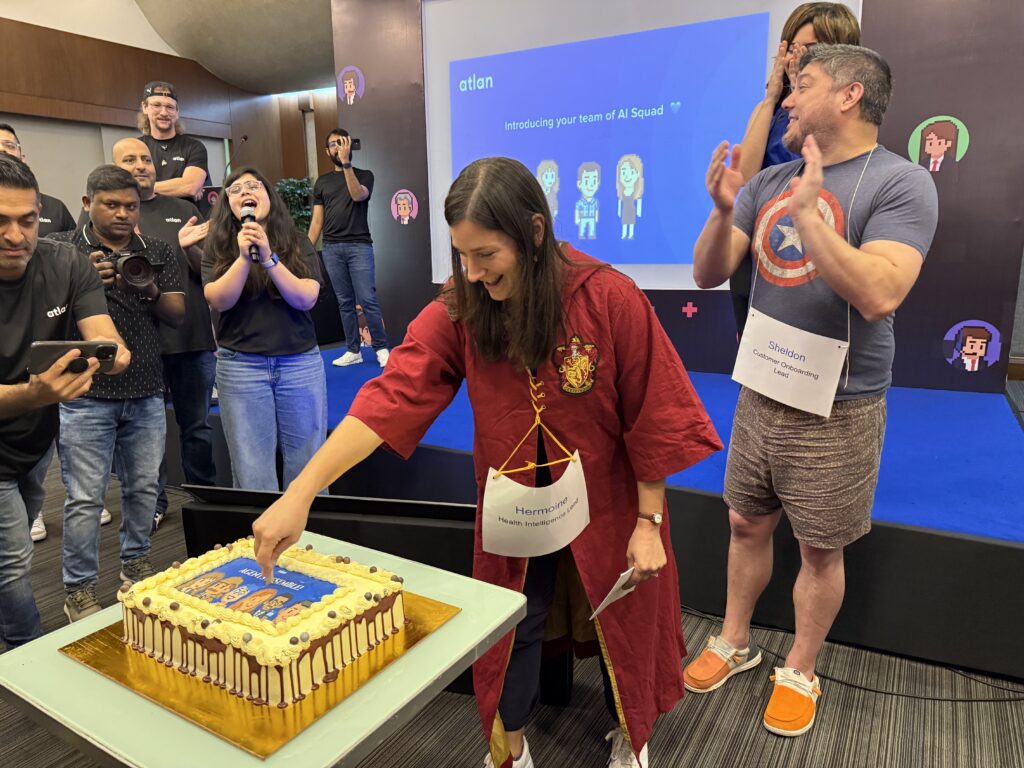
- CX team wide rollout with an in-person offsite designed around role transformation, complete with team members dressing as their AI agents
- Physical AI Squad dossier, a cake cutting welcome ceremony for our AI squad, and humour to introduce AI agents as teammates with distinct personalities, not faceless tools.
- Result: In 6 weeks since launch, we’ve seen a breakthrough – 5,000+ agent runs and fundamental shifts in how the team approaches customer success work.
Our Tech Stack:
- Agent Orchestration: Relevance AI
- Context & Governance: Atlan (yes, we dogfood our own platform)
- Data Layer: Snowflake + structured/unstructured data from Gong, Slack, Zendesk, Vitally
- LLM Gateway: Custom open LLM infrastructure
The Results: 5,000+ Runs and Dramatic Time Savings
Just 5-6 weeks post-launch, both our usage metrics and team feedback reveal the transformation’s impact:
Quantified Time Savings:
- EBR prep: From 4+ hours → 1 hour (“minimum 4 hours of prep time… with Hermione, our AI Health Intelligence Lead, it has come down to 1 hour”)
- Executive summaries: From 4-5 hours → Under 5 minutes (“I could get that done in under 5 minutes”)
- Ticket analysis: Complex account reviews from hours → 5 minutes (EasyJet ticket pull: “hours quicker… would have taken me an hour, it took me 5 minutes”)
- BOB reviews: 50% time reduction through centralized workflows
Adoption Success:
- 5,000+ agent runs across the team in ~6 weeks
- “I’m trying to never do a timesheet manually again” – team feedback on automation
New Strategic Capabilities: Our agents don’t just save time—they unlock new insights. As one team member noted: “I wouldn’t have normally picked up key trends and adding it via Json, our AI Product Analyst… it gives me new insights on new areas to explore, new topics of discussions.” The shift from reactive work to proactive strategy is exactly what we designed for.
The transformation is perhaps best captured in one team member’s experience: “I used Hermione to pull account intel, cross-referenced it with insights, and created a complete EBR on a key account in under 1 hour. What used to take me minimum 4 hours of digging through Gong, Vitally, and endless tabs is now a streamlined 60-minute process with deeper insights than ever before.”
What’s Next: Building the Future of AI-Native CX
We’re organizing like an AI product team now, complete with sprint cycles and a formal product roadmap. Our immediate priorities:
Native Integrations: Moving beyond “go to Relevance and call an agent” toward bringing AI directly into workflows. Slack integration is our next major milestone—imagine getting instant account intelligence without leaving your conversation.
Alert-Based Automation: Every usage spike triggers automatic reports. Every risk signal generates proactive outreach recommendations. We’re building a system that thinks ahead, not just responds to queries.
Continuous Innovation Process:
- Agent request submission system
- Enhancement and feedback workflows
- Bug vs. feature triage processes
- Dedicated adoption and change management track
The future we’re building isn’t just about better tools—it’s about reimagining what customer success looks like when AI handles the routine so humans can focus on the relationship-critical work that truly drives customer outcomes.
Key Learnings: What We’d Tell Other CX Leaders
Workflow redesign trumps agent building every time. The secret sauce isn’t building the perfect AI agent—it’s fundamentally rethinking your workflows first. Pick the right problem to solve, then build the solution. We learned this through our evolution from generic tools to specialized agents.
Specialized beats generic, always. One super-agent that does everything poorly loses to focused agents that excel at specific jobs. Our individual agents for health intelligence, onboarding, and support analysis consistently outperform any “do-it-all” approach we tried.
Data quality is non-negotiable. AI confidently delivers wrong answers when fed poor data. Invest heavily in data quality, governance, and validation before expecting reliable AI outputs. This is where most AI initiatives fail.
Context is king—build feedback loops from day one. Create continuous context feedback loops and iterative approaches to keep improving accuracy. AI systems get better with use, but only if you design learning mechanisms into the process.
Community and change management are make-or-break factors. Technical implementation is table stakes. The real challenge is human adoption. Our team contests, costume parties, and gamification weren’t just fun—they were essential for driving engagement and overcoming AI skepticism.
Structure your team like you’re building a product. Organize into focused execution pods: AI Platform team (infrastructure), AI Engineer team (agent development), and AI-Ops team (context and governance). This isn’t a project—it’s a permanent organizational capability.
Ship fast, learn faster, pivot when needed. Speed of iteration matters more than perfection. We learned more from our “failed” iterations than what our months of planning could have taught us. Build, test, learn, repeat.
Customer success has always been about predicting and preventing problems while maximizing growth opportunities. AI hasn’t changed that mission—it’s finally made it achievable at scale. The organizations that recognize this first will define the next decade of customer experience.